Comprehending Peptide Purity: What 99%+ Actually Means
Peptide Quality Control & Purity Testing Boc Sciences
Pinnacle Laboratory is a customized distributor of high-purity chemical reagents and peptides. All products detailed are strictly for in-vitro lab r & d use just. Discover flagship study peptides with batch-specific COA documents and HPLC/MS confirmation. Products are for in-vitro lab research usage only and are except human consumption.- We use innovative reverse-phase HPLC to figure out the pureness of customer peptide samples.
- Identity screening validates that what was synthesised is in fact the desired sequence.
- We aid identify chromatographic pureness from real peptide amount so customers can prepare remedies and compare lots with better confidence.

What Do Purity Degrees 95%, 98%, 99% Mean?
BOC Sciences uses multi-batch comparison evaluation to help customers develop basic material top quality criteria and guarantee uniformity. Residual non-peptide components can transform assay analysis, distort peptide material estimations, and make complex lot credentials. We support targeted analysis of relevant residuals based on the project and sample background.
Typical Purity (≥ 95%)
At Maxed Out Substances, every item we provide features a clear testing record and transparent documents. Our objective is to support researchers with high-purity, validated compounds that satisfy the demands of contemporary scientific research-- nothing more, nothing less. Independent, third-party testing plays a crucial role in making sure objectivity and accuracy. By using outside labs for confirmation, suppliers remove predisposition and promote scientific integrity. It's an extra step that offers scientists self-confidence that each peptide satisfies consistent, verifiable criteria. This grade fits most of in vitro research applications-- receptor binding assays, enzyme task researches, and cell society experiments.A sample could produce a clean-looking chromatogram with one dominant optimal and still be the incorrect compound if identification was never ever validated. HPLC procedures splitting up and family member peak area; mass spectrometry procedures mass-to-charge actions that can be used to validate molecular identification. Peptide purity screening is the procedure of validating that a peptide sample consists of just the designated series-- and no significant pollutants or results from synthesis. Because peptides are produced through intricate chemical processes, trace impurities can form naturally. Checking allows researchers to recognize precisely what's in the vial, confirming both identification and high quality. Choosing a trusted third-party laboratory is vital to getting trusted peptide validation outcomes.
Extremely few commercial study peptide providers supply MS/MS information on routine COAs-- it is generally scheduled for pharmaceutical-grade products and progressed research setups. However, some costs vendors do provide it on ask for important sets. If sequence confirmation is essential for your research study, this is the evaluation to demand. It separates the parts of a sample based upon their differential fondness for a stationary stage (column packing product) and a mobile phase (solvent system relocating via the column). Peptides, with lengthy molecular sequences and varied conformations, present challenges for framework verification and material resolution. BOC Sciences leverages high-resolution mass spectrometry, LC-MS/MS, and NMR to properly examine molecular frameworks and provide very delicate measurable assistance.
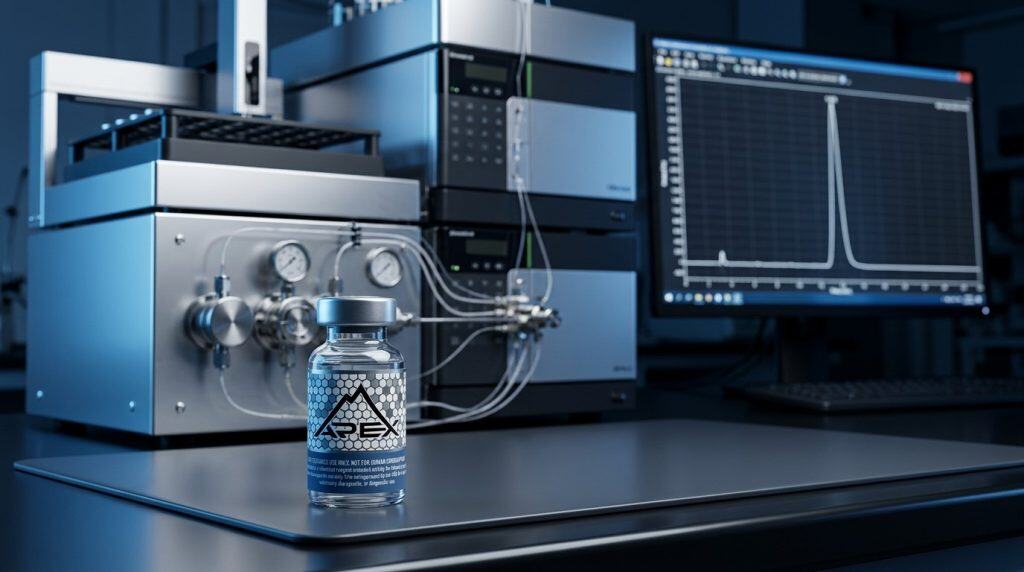
A useful assay gauging downstream signaling-- or a structural research using NMR or X-ray crystallography-- demands the highest purity readily available. Crystallographers in particular frequently need ≥ 98% purity because even small pollutants can prevent crystal development or present problem into the crystal lattice. As particles exit the column, they travel through a detector-- generally a UV detector set to 214 or 220 nm, wavelengths where the peptide bond absorbs light strongly. The detector documents just how much UV light is taken in with time, producing a graph called a chromatogram. This overview breaks down what purity really indicates in peptide chemistry, exactly how it's determined, what the impurities are, and how to read the paperwork that verifies a peptide is what it declares to be. The dissolved peptide example is infused into a stream of liquid solvent (the mobile stage) that streams through a tube packed with tiny particles (the stationary phase). Different particles "stick" to those bits with various toughness, so they travel through the column at various rates. Refined differences in basic material pureness and structure can lead to disparities in the task of the end product.